Monday, July 10, 2017

Colombia by Land


While it took us weeks to make it a few miles down the Colombian coast, we now accelerated our pace quite quickly with a short flight to Medellin.  With the boat safely snugged up in Cartagena, we headed to the the hometown of one of the most famous  Colombians, our childhood friend John Tobon. Not coincidentally the city was also home to the very successful 80's drug lord Pablo Escobar. (If you haven't watched the Netflix series Narcos, now is a very good time to do so!)

Medellin was the first place we would visit with any sort of elevation to it. Set in a valley, there were many steep hills to be climbed, prompting many stares from locals as we sweated and struggled to catch our breath. The bus from the airport set us down in the heart of the city, a short walk (uphill) to our swanky AirBnB for the next four nights.
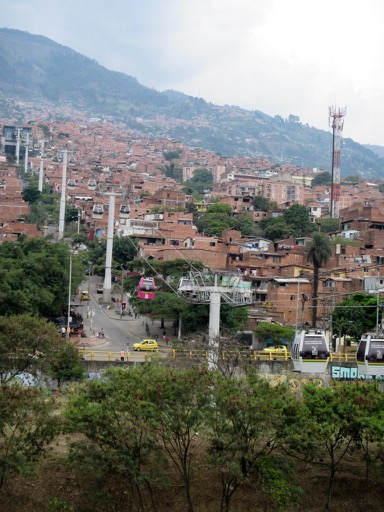
View of Medellin

Botanical Gardins


Medellin
The city far surpassed our expectations. In just a couple of days we fully explored the beautiful Jardin Botanico, admired the chunky sculptures in the Parque Botero, took a long walk along the river, ate a lovely meal at a vegetarian restaurant in the Prado neighbourhood, rode the packed metro lengthways through the valley and the precarious cable car up the side of the valley. Due to the bowl shape of the terrain, you can see almost every building from every other building, making for a beautiful view at night. It is evident that the people that live here are still cautious but are enjoying a new, modern Medellin that is growing in a positive direction. They are very happy to show off their city to tourists!
Parqueo Botero
Botero Sculpture

Botero Sculpture
Medellin Cable Car
With one day left at our little apartment we decided to get out of the city to a lovely little town a short bus ride away called Guatape. The town is in a lovely setting by a lake surrounded by hills with little cafes, shops, and restaurants scattered about. The building are renowned for their bright paint jobs, each having a mural on its side depicting the lives of a person that lives in or used to live in the house. If you wanted to find the village grocer, fisherman, teacher, or priest, it would not be difficult.
Guatape Mototaxi

Guatape Cafe

Guatape

Murals


Leaving Medellin was our first experience with long-distance bus travel in South America. Here is a short comparison of travelling by bus in Canada and Colombia:

  • Fares: A hour's trip on the Greyhound from Niagara to Toronto is about $25. 2.5 hours from Medellin to Jardin is $12 and that is on the pricey side!
  • Companies: You can count on one hand the number of bus companies in Canada, and for any destination you can usually count it on one finger. In most South American countries bus travel is available from private companies. These companies choose where they will stop, the quality of their buses, what they will charge, etc. It never hurts to keep a mental note of the bus companies that are always broken down at the side of the highway.
  • Entertainment: If you're lucky you will get a movie from the 80's played on a tiny little TV monitor on a longer Greyhound trip. In Colombia if you're lucky you'll get a movie from the 80's played on a tiny little TV monitor. If you're unlucky you'll get people getting on at each stop to sing, play instruments, tell stories, tell jokes, do magic tricks, ...
  • Stops: I used to get impatient because a bus from Toronto to Niagara would stop in Grimsby and St Catharines. That will never bother me again! Buses in Colombia will stop in every town, on every street going into and out of every town, or just when anyone wants to get on or off the bus. There is also no such thing as a full bus, there is always room for one more!
  • Food: If you're taking the bus in Canada you either need to eat a very large breakfast or bring a large sack of junk food. When we brought our own food on the bus in Colombia, Colombians rolled their eyes at us as if to say "amateurs". At every stop, and especially when stopping at "payajes" to pay the toll, there are vendors selling: candy, gum, chocolate, ice cream, chips, popcorn, homemade popsicles, empanadas, mangos, mandarins, tamales, plantains, chicken, fries, and many other things we had never heard of. And if that weren't enough, around lunchtime, buses will typically pull over at roadside restaurants for a full almuerzo, a five-course meal that will leave you wishing you wore your elastic-waist pants on the bus.
I can only imagine that a Colombian new to Canada might take a bus ride and be hungry, bored, confused, and broke!

Our first bus ride took us to the town of Jardin in the heart of the Colombian coffee growing district. The main square was massive and surrounded by dozens of bars serving coffee in dainty little cups to the farmers that had come into the city. We took a little mototaxi up the hill to our second brilliant AirBnB run by Gladys, a little woman bursting with energy and life that spilled over into her cooking, gardening, and conversation. Her house was perched overlooking the valley with a beautiful walk to where a statue of Cristo overlooked the town.
Jardin Main Plaza


Cafe!

Valley Around Jardin


Jardin

Cristo

Casa de Gladys
Leaving Jardin by bus was a bit of a harrowing experience. We had been assured by everyone that there were frequent busses only to find out when we arrived that there were two. And the only one left that day only went to Riosucio. Rio-what??? It turned out that this popular bus route wound its way through the Andes along very steep cliffs high in the clouds with washed-out roads and frequent landslides.  Not only were we the only gringos on this decrepit old bus, we were the only people full stop! After a bone rattling 35km trip that took almost four hours, we arrived in the tiny town of Riosucio where we were able to catch what was actually a frequent bus to the city of Pereira.
Waterfall Near Pereira
Pereira was then only a short(er) bus ride (you're sensing the theme here) from the coffee town of Salento. We stayed outside of Salento in a farm-converted-into-a-hostel with unlimited coffee (!) and a dog or cat outside every door. Salento is a lovely town in its own right, but is only a WW2 jeep ride away from the Cocora Valley, home to hundreds of massive wax palms, and several small coffee farms from which you can take your pick to do a tour and tasting.
A Dog or Cat Outside Each Room


Near Salento

Salento

Wax Palms


Salento Coffee Tour - Don Elias


Next stop was the colonial city of Popayan, one of our favourite Colombian cities due to the beautiful architecture, friendly people, and fewer tourists in this area. After a somewhat questionable first night's stay, we decided to splurge for a night and stay in an old monastery that had become a posh hotel. After giving the porter an embarrassing tiny tip because we didn't have any small bills, we retreated to our room for a luxurious hot shower. (We were slowly learning that hot showers were a rare commodity in the Andes. If you were lucky, your shower had a bizarre-looking showerhead with wires coming out of it whose job was to heat the cold water in the brief moment it travelled from the wall to the end of the showerhead. What a simple pleasure to find that sweet spot that maximizes water pressure and warmth!)
Popayan


Monastario Hotel


Popayan Parade
Popayan is a five-hour bone-breaking bus ride to the town of San Augustin whose claim to fame is the discovery of dozens of stone statues over 2000 years old. The final 10km took place in the back of a pickup truck shared with a nun and a couple of backpackers amidst sheer cliffs and waterfalls. We found our hostel, the Casa de Francois, a very steep walk up from the town. But staying in an adobe cottage sourced from local materials was certainly worth it. The stone statues did not disappoint either.
Casa de Francois

Casa de Kate
Stone Statues


After a short trip back to Popayan, we were back on the bus to the southernmost town in Colombia: Ipiales. This is a very picturesque bus ride through the mountains. Other than being quite high up and thus chilly, the most notable thing in Ipiales is its lovely church set into a gorge and bridging the river. Thousands of Catholics have made pilgrimages to this relatively new church, evidenced by all the plaques set into the wall. We made our pilgrimage and returned to Ipiales where the next day we would take a collectivo (shared taxi) to the Ecuadorian border. Adios, Colombia, but we will be back soon!
Southern Colombia


Pilgrimage

Ipiales Church


Sunday, July 9, 2017

The Lost City

Hiking to La Ciudad Perdida, the Lost City, is a right of passage for travellers to the northern part of Colombia. Is it a city? Not really. Is it lost? Not exactly. Is it five days of intense hiking in the thick Colombian jungle on a trail so muddy and steep that the only way back to the nearest village is on the back of a mule while trying not to puke one's guts out? Absolutely, yes!
The Mountains Around the Lost City
Santa Marta is a sizzling hot coastal Colombian city with a lot of offer. But after several weeks with the foothills of the Sierra Nevada mountains staring us in the face we were starting to get an appetite for further exploration. The hike to the lost city is a 4-6 day guided tour through the mountains to a stone archaeological site that was built around the year 800 and considered holy by the local indigenous tribes. Our English friends Paul and Lily on Delphinus had just come back from the hike and are either in really great shape or were exercising their British sense of humour as they recommended we partake in this moderately easy hike through the "hills". They also suggested a tour operator called Magic Tours. After shelling out the 1.6 million peso fee for the tour, we were kind of committed. Our travel buddies on Aqua Vida signed up as well so there was definitely no turning back!

Papaya!
Day 1
Paul and Lily warned us that when you arrive as instructed at the Magic Tour office at 8:30 you are perfectly on time... for a 1 1/2 hour wait. You see,  "on time" for Colombians, and South Americans in general is at least 20 minutes after the scheduled time. You are technically only late if you don't show up at all and even then you might be able to still pull it off. This applies to opening times, meetings, bus departures, and apparently tours as well. So at 10:15 fourteen of us crammed into two Land Rovers and started the drive to Machete, the start of the hike.

By lunch time we had pulled up to a restaurant in the small town, which was the largest we would see  for several days. We were introduced to our guide Nicolas, translator Abraham, and the two cooks that would hike with us the entire way.
Welcome to the Jungle
After a quick meal, we started walking. If there is a specific moment in life when one realizes "oh, I'm now middle-aged" it can be traced back to the afternoon of February 1, 2017. This is when we found that despite believing we were in good shape we were unable to keep up with the younger members of our group who seemed to be ascending the trail without sweating or running out of breath. They would easily beat the "older folks" to the checkpoint but thankfully took pity on us and left us a few pieces of orange and watermelon. As the elevation increased we were treated with outstanding views of the valley below. Farms with cows and horses sprinkled around banana, papaya, and other fruit trees took on a golden light as the sun started to descend in the late afternoon. At first we made an effort to avoid stepping on the giant ants that crossed the trail carrying their large pieces of green leaves but we soon stopped noticing them altogether. Just as we started to feel like we had found a good rhythm, we peered in to the valley at the first camp. The cooks were already putting the final touches on dinner as we chose our bunks, had a quick swim in the river, and opened one of the most delicious cans of beer I've ever tasted. At 7:30 we crawled into bed and let sleep wash over us. Unfortunately it would not last long.
Giant Ants

Snack Time

Happy Hiker


Day 2
A few minutes after falling asleep, James and I were rudely awaken by loud breathing in the bunk next door. Very far from what you might be thinking, the breathing was the precursor to the loudest snoring I've ever heard in my life. Even with earplugs in and being exhausted, the irregular snoring rattled our brains and managed to keep us awake most of the night. We won't name names because we don't know the man's name, otherwise we would.
Camp
We knew it was time to get up when we could smell the fresh cafe and hot chocolate wafting through the camp. It had rained most of the night so somehow our soaking wet clothes were even more wet than when we rinsed them in the river. After a quick breakfast we were herded onto the trail.

Wiwa Village


Piglet

Toucan!

Although the second day was the most difficult part of the trail, the views were worth it. The muddy trails took us even further into the jungle, climbed higher into the mountains, and past indigenous Wiwa villages. The Wiwa people we encountered were shy but friendly and blew us out of the water in terms of physical ability. Men, women, and children, young and old whizzed past us going up and down hill, carrying sacks full of fruit, vegetables, and babies, and usually in bare feet!

By the time we made it to that night's camp, everyone was exhausted and crashed in the hammocks scattered around the camp. By that point, news of last night's snorer had made its way throughout the group but we managed to secure a bunk that was well away from the disturbance and had a much better night's sleep!

Day 3
The third day marked the final climb to the lost city. After some level ground and wading through the river we approached a stone staircase that was very steep, slippery, and with stairs designed for little feet. Just when it felt like the stairs would never end we asked our translator, Abraham how far we had left. When he said "you're about halfway now" we considered packing it in and heading back to the camp. We're glad we kept going as we were only two minutes from the top - the cheeky sod!
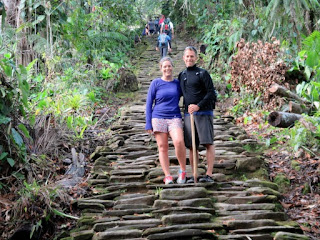
The "easy" set of steps

 Reaching the Lost City made the hours and hours of gruelling hiking worth it. The "city" is located between two river valleys and is built on the top of a steep hill. It features round stone foundations on which dwellings and religious buildings would have stood. Although the site was "discovered" by grave robbers in the 1970's the indigenous people in the area have known about it continuously throughout the years. Excavation of the site has been undertaken with the help of the Colombian government and the site is once again used for ceremonial purposes.
The Lost City

We were able to explore the sacred site for a while, having it pretty much all to ourselves. We climbed up to the top, which is overlooked only by a small Colombian army base which must either be the most coveted or worst posting in the military. Either way they were smart to be wearing boots as I had to pull a tick out of James' leg!

Lost City
On our way down we visited the nearest indigenous settlement and spoke with the Mammo, the religious leader for the area. He was chewing on coca leaves in the traditional manner, adding crushed lime powder from the gourd he carried with him. Our guides chatted with this wise man for a while. When they asked him what he saw as the biggest problem faced by his community he responded that people are not aware of the effects their lifestyles have on the natural environment. The indigenous people are traditionally seen as the guardians of the mountains and the river valley and they have managed to maintain the area as it was for hundreds of years. However this has not been without having to withstand the pressures put upon them by the Spanish and other westerners. They have had to defend their land against mining, forestry, excessive farming, and now excessive tourism. In fact, we wondered how many other "lost" cities had yet to be "discovered" and that perhaps this one was merely a sacrificial decoy.
Kate and the Mammo

Day 4
Returning along the same route we had just hiked was bittersweet. Yes we had made it through the jungle to the Lost City, but now we had seen everything along the way and we knew what a gruelling time we were in for. Thankfully it was slightly more downhill than up. At this point in the trek, hikers were able to choose between a four- or five-day hike. Most of the young-ins chose to finish early as it meant they could spend an extra day and night at the bars in Santa Marta.

We said goodbye to about half of the people in our group, including the snorer. We were very fortunate to have a group that got along very well and had similar interests. We have stayed in touch with many of the people we met on the Lost City hike. Meanwhile, the seniors in the group returned to the first camp we had stayed at on the first day.

WARNING: This part is gross!!
Along with a few other people in our group, I had been feeling a bit under the weather the previous night but was much better now. The day before some of our crew were throwing up along the road or back at camp. Almost as soon as we had eaten lunch at the camp, James disappeared to the bathrooms. Shortly after, our friend Danielle came back and let me know that help was urgently needed. James was very sick in the bathrooms with food and/or water poisoning. The bathrooms were fairly basic but did have flush toilets (which seemed to flush just out into the jungle). There was no buckets to be found so poor James was throwing up into a plastic cutout patterned garbage can with no bag in it. The only thing preventing the vomit from running freely out of the holes was all the used toilet paper filling the can. We very nearly had two people vomiting in that bathroom when I had to empty the garbage can into a plastic bag. I helped him into his bunk but knew we would have a long and disgusting night ahead and getting him out of the jungle the next day might be a bit of a challenge.

Day 5
When it was time to leave the next morning, James had recovered enough to have some Gatorade and start the hike. There was an option to ride on a mule or, once we were over the next hill, ride back to town on a motor bike but he wanted to try walking. Thankfully we were closer than we thought and we were back to the village of Machete in no time. After a short ride on some very bumpy roads, we were back on the highway to Santa Marta.
One of our guides, Gabriel

Our Translator Abraham
In the end, around half of our group had gotten sick on the hike in some way. We were glad we did it, but VERY glad to get back to the marina. One of the best parts of the hike was meeting lots of new like-minded people, including Thom who is sailing single-handed around the world, and James and Belle who are driving from Alaska to Argentina in their van. We invited them back to the marina for unlimited hot showers, which Overlanders seem to appreciate just as much as cruisers...

Saturday, July 1, 2017

Santa Marta

The passage between Aruba and Colombia is frequently described as one of the world’s roughest. As you approach Santa Marta, the winds coming off the Sierra Nevada mountains can combine with thousands of miles of uninterrupted Caribbean sea to create a very windy and very rough section of water. Out of the 300 mile passage it’s the last 10 that are supposed to be the worst! Jimmy Cornell, who is apparently a world cruising guru recommends making this passage in November-December or April-May.


Santa Marta

Approaching Santa Marta
Being January, we spent a long time waiting in Curacao for the high winds 300 miles away to abate. We waited patiently with our friends from Noomi who were crossing north-west to Haiti for about two weeks and just when it seemed the winds would never stop, they did! Our patience paid off: almost all of the boats that left before we did suffered some kind of damage along the way…:(  
Passage to Colombia

Approach to Cabo de la Vela

The first leg of the journey took us to Aruba where we anchored off of the beach with the fancy hotels that make Aruba famous. There we met up with a boat called Aqua Vida, from Florida, whom we had never sailed with but had been stalking since the Bahamas. Ken, Danielle, and Kaylee (and her pet hermit crab Peanut) were also headed to Colombia so after a couple of quick repairs we would leave in the morning.
Cabo de la Vela

Kiting Paradise

Aqua Vida at Cabo de la Vela
Leg 2 was a fairly easy overnight to Cabo de la Vela, Colombia. This northern part of Colombia is essentially a desert on the Caribbean, inhabited by the native Guajiro people and catering mainly to kitesurfers. We could see why - as we rounded the cape the calm winds cranked up to 28 knots in the protected bay. We were the only two cruising boats in the bay and had a great afternoon exploring the small beach town. This area is well known for weaving colourful shoulder bags and hammocks as well as providing a place for tourists to sleep in hammocks on the beach for $2! We were somewhat restricted here for a couple of reasons. Although we tried to obtain Colombian Pesos in Curacao, the banks there would only trade our Antillean Guilders for US Dollars, which are used only in Bonaire. Also there is nowhere to clear in to Colombia in Cabo de la Vela so technically we weren’t allowed to set foot on shore, sssshhhhhhh!


Overnight to Santa Marta


The next morning we had an early morning visit from a fisherman and his two boys in a dugout canoe. They were hoping we had some snacks they could have for their day on the water. Unfortunately all we had was some cookies and sugary lemonade - not a very healthy snack but the boys eyes lit up when they saw the bottle of pop!
Santa Marta Playa


Approaching Santa Marta

We set out with Aqua Vida on Leg 3 around 8am, hoping for a similar arrival time in Santa Marta the next day. It was a pleasant downwind sail along the Colombian coast throughout the day. As the sun went down, the winds and swells did start to pick up, but nothing like we had been seeing on in the forecast for the previous two weeks. Thankfully once we shortened sail, the autopilot behaved and we could take turns getting some sleep. Other than some lightening well off in the distance, the night was fairly uneventful. When the sun came up we could just make out the outline of the mountains, reaching a height of almost 19,000 ft.

We passed the beautiful Tayrona National Park and rounded the point into Santa Marta. Although we usually don’t spend much time in marinas, with the winds still forecast to pulse every night, we decided to pull in to the marina in Santa Marta. We were met by our friends Jayne, Paul, Lilly, and Sky on Delphinus whom we had met in Grenada and shared Christmas in Bonaire!

********

Around Santa Marta


Don't Touch!


Jugo!

Santa Marta Main Square

Santa Marta is the ideal city to welcome tourists to Colombia for the first time. The weather is hot but the winds keep you cool. The people are very friendly and learning to understand their rapid-fire coastal Spanish puts you in a good position to understand the slower speakers further inland. The city introduces you to all the fruit you know, but never knew could taste so good, and just as many types of fruit you never knew existed! And it does so both in raw and juice form. For just 1000 Colombian Pesos, or about 45 cents Canadian, you can have an ice-cold cup of fresh lime-ade. And, get this, the custom is to drink about half the cup as a “taste” and hand it back to the vendor who will top you up. Almost as addictive as street-side mango and watermelon slices, mandarin oranges, empanadas, arepas, and just about any kind of sweet you can possibly imagine. Off the top of my head, here’s a list of our favourite Colombian fruit:

  1. Granadilla - waxy orange outer shell that you break open to reveal sweet crunchy seeds
  2. Lulo - orange and green, looks like a tomato; too tart to eat on its own but makes incredible juice
  3. Maracuya - mix these passion fruit seeds with yoghurt and your breakfasts will never be the same
  4. Curuba - looks like a small banana, but if you slice it lengthwise the tart seeds will just pop into your mouth
  5. Mora - looks like a blackberry but packs a much bigger punch
  6. Tomato de Arbol - literally “tree tomato” these fruits do look a lot like tomato and taste like a sweet tomato; we never got into the juice but they taste great on their own
  7. And the usuals: banana, pineapple, oranges, papaya, all fresh off the tree.
Curuba


Granadilla

Granadilla Seeds


We spent several days exploring this lovely colonial city, wandering around checking out the Spanish-style architecture, visiting both the touristy and non-tourist areas, the market, having delicious meals with our friends at the marina, and just enjoying being in Colombia. And of course we were resting up for our five-day hike into the Colombian jungle in search of… The Lost City.


*** Note: Colombia hasn’t exactly been having an easy go of it in the past half-century. But we are lucky enough to be here at one of the most peaceful times in the country’s recent history. Drug-related violence (fuelled by the west’s appetite for those drugs) has quieted down considerably and the government has signed a peace agreement with the largest group of rebels. It feels like Colombians all over the country are awakening after a bad storm and are rejuvenated at the prospect of a bright future. As the billboards advertise: Un nuevo pais!