Monday, March 5, 2018

Boatwork in Exotic Places


After our time in busy Cartagena, the quiet and solitude of Kuna Yala was most welcome. We sailed 100 nautical miles without seeing another cruiser. Although it was incredible to have our pick of beautiful deserted islands near which to anchor almost every day we also had to use caution. With the exception of the Kuna we were truly on our own here. We were on constant lookout for the plenty of uncharted reefs that could have punctured the hull and stopped us in our tracks. Not too mention our first exposure to the sort of jungle wildlife not found anywhere else. Pumas, wild boar, snakes, monkeys, and crocodiles were all to be watched out for. The one crocodile we did spot from our dinghy was at least ten feet long and ruled out any plans we had to snorkel in that anchorage!


We spent weeks swimming, snorkelling, exploring the isolated villages and watching the strs at night. One night in particular felt like we were anchored directly under the milky way - with zero light pollution in the jungle the stars felt like they were right on top of us! Since our outboard was acting up we also spent our fair share of time paddling our dinghy around - thank god for Arkin's hand carved paddle! When we grew tired of paddling one of us would hop in and push the boat along.


Aside from being off the beaten track the lack of other gringos was also because it was still the end of rainy season. You could set your watch to the dark black afternoon clouds that formed over the mountains and dropped a couple of hours worth of rain (and usually thunder and lightning as well) on the islands. Although we had a few intense squalls, we did not encounter the feared Chocosana, the sudden intense storms with tropical storm force winds.


As we worked our way west at a leisurely pace, the traditional villages gave way to larger, more westernized settlements. At Nargana, there were hostels, small shops, and a cell tower (but no SIM cards available for purchase). There was also a bakery and a place to buy fresh fruit and veg and it couldn't have come soon enough! At the Hollandes and Lemon Cays we found the couple dozen other cruisers at anchor and we sadly realized that the short break we enjoyed from the rest of the world was drawing to a close…. or was it?


Anchored amongst the backpackers - sailboats from Panama to Cartagena are one of the most popular ways for those backpacking Central and South America to cross the Darien Gap - at Chichime, we discovered a steady leak coming from our engine’s seawater pump. We had encountered this problem before, almost two years ago while motoring through the “Dismal Swamp” in North Carolina. Since we were such newbies at the time, another cruiser kindly helped us rebuild the pump, but now we felt confident we could do it ourselves, in the middle of nowhere, surrounded by coral reef. It was a close call when we damaged the threads on the pump shaft (maybe bashing it with a hammer was not the best way of removing the old bearings) but sweet relief when we found a spare shaft buried deep in a drawer. We would be able to leave Kuna Yala after all.

Friday, March 2, 2018

Kuna Yala - Canoes and Crocodiles


Not only is Sapzurro the last Colombian town heading west, it also marks the clear separation of South America and Central America. If it weren’t for this little stretch of jungle known as the Darien Gap it would be possible to drive your car all the way from Alaska, USA in North America to the tip of Argentina in South America. As it stands, you would need to ship your car by sea from Panama or Costa Rica to Cartagena.


Kuna Yala
Kuna Dugout Canoe

For once, a sailboat had the speed advantage over a car and in three hours we had crossed the Darien Gap into Kuna Yala. Like most people outside of the sailing and backpacking communities, we had never heard of Kuna Yala (or San Blas as it’s known in Spanish). This territory of Panama is completely autonomous and governed and settled by the Kuna indigenous population.

Morning Fishing in the Bay

The terrain here is beautiful but challenging, mostly jungle, with steep mountains rising from the coast. You can understand how and why the Kuna successfully fought to keep control over their land.
The eastern part of Kuna Yala, where we made landfall, is much more traditional than the west. Villages are small and dense with fishing and farming being the primary activities and sources of income. Most Kuna families have their own plot of farmland to grow plantains, bananas, and coconuts. It is illegal for anyone to take a coconut in Kuna Yala unless it is on his or her own land or purchased from someone else. Fines for tourists can be especially stiff. In fact, until the later part of last century, coconuts were the only form of currency used in Kuna Yala (replaced by the almighty US dollar).

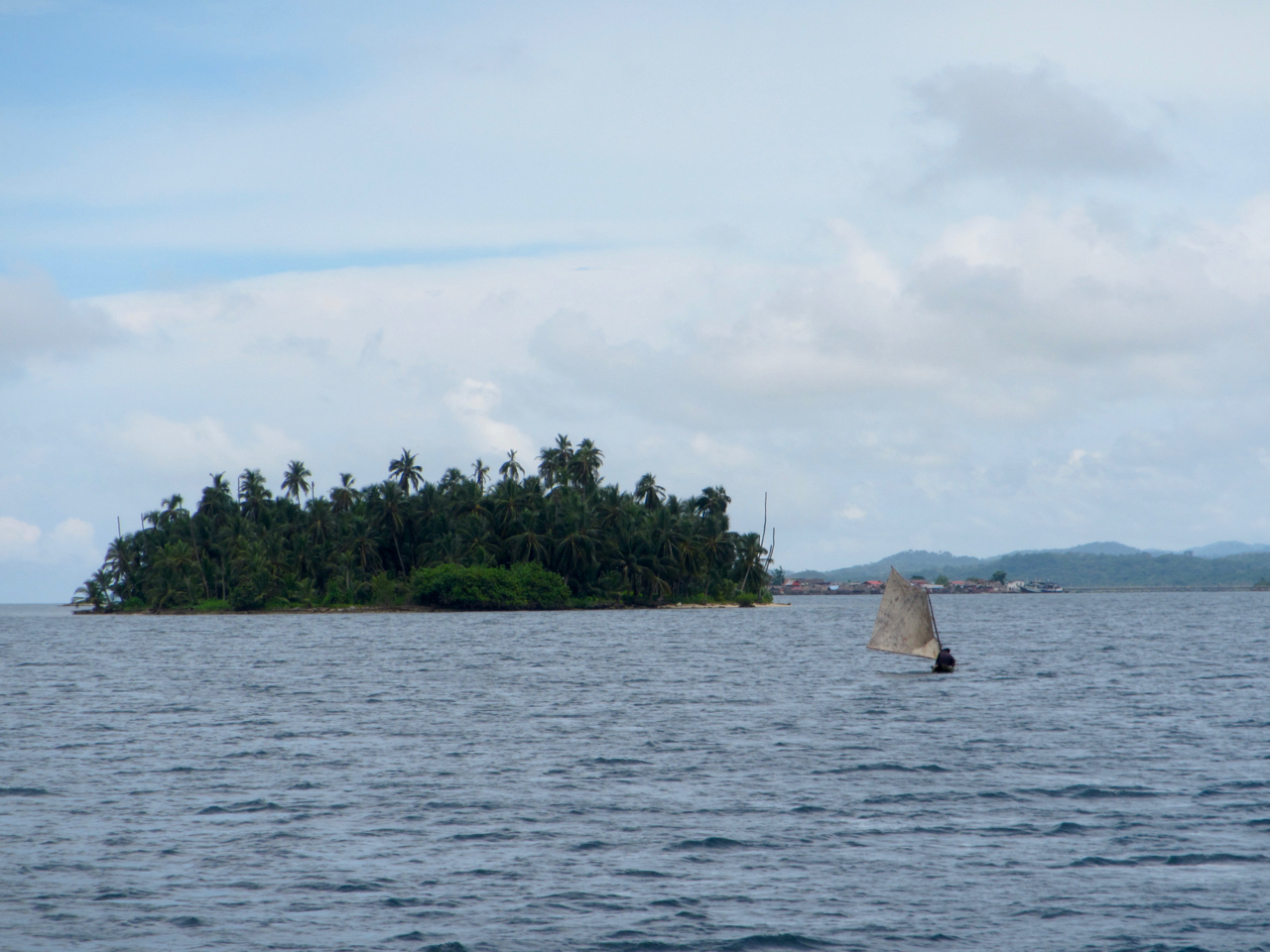
Kuna Sailboat

Fishing near these villages is a communal activity, with dozens of dugout canoes meeting in the middle of the bay to fish and socialize.

Whaaaaa! Jungle Bug

The first village we came to we were visited by two Kuna in a canoe. It turned out that one of them was the chief, or saila, not just for the village but for all of Kuna Yala. We were informed that the saila would like to come aboard and also that he would like a cup of coffee. We also offered the chief some pancakes we had just made, a breakfast that he seemed to find quite amusing. 
Dugout Canoes

Once the niceties were out of the way the chief stated that it would cost us $20 to anchor there but this included a tour of the village and a swim in the river. Although this was an expensive anchoring fee by any standard, we knew we would have few chances to experience a more traditional village on our own. We had known that the Kuna were shrewd business-people, but at this rate we wouldn’t be able to make too many stops with our envelope of US bills we had withdrawn from TD in Canada.

Toucan (I did not realize that this photo would cost me 1USD)

What appeared to be a quiet and small place from the water was colourful and full of life and as our guide led us through the sandy alleys. Each wood stick roundhouse with palm thatch roof had a fire burning inside and multiple generations of the family lounging on brightly-woven hammocks, looking after rambunctious toddlers, or doing the usual household chores. We enjoyed a glass of soursop juice before heading to the river for a dip. It seemed that half the village was swimming, bathing, or doing their laundry in the cool fresh water of the river.

Mono River

Our fears of going broke were unfounded as we were only asked for an anchoring fee in one other location. The opinions held by the Kuna on “merghi’s” like us (bastardization of American, a blanket term for all foreigners) seemed to be quite mixed. Anywhere from ambivalence, to welcome, to the opportunity to make money, to a desire to protect their traditions by keeping their society closed and the merghis out. As with most things, money appeared to be winning. 

Dusk in Kuna Yala


One of the most beautiful anchorages we encountered as we moved slowly west was Mono (Monkey) Island. We anchored in the middle of a stunning crystal clear bay which was great for sleeping as it was completely flat. We thought it would also be great for swimming and snorkelling until we were in the dinghy just about to get our snorkel gear on when we saw what looked like a 3m long log around the corner from where we were about to snorkel. Since it was a very funny shaped log, we aborted the snorkelling and headed back to the boat to check it out in the binoculars. It was a bonafide croc! And as it stayed in that area for the remainder of the afternoon, we opted to stay dry and sweat it out on the boat.

Isla Mono (Crocodile Not Pictured)

When You Run Out of Crisps You Must Improvise


At Snug Harbor we were welcomed by a man named Arkin who would paddle out to see us every day on the way to his farm to say hello, exchange stories, and see if we needed anything. We asked if we could buy some coconuts from him and ended up paddling with him to his farm to get the coconuts directly.


Paddling to Arkin's Farm

No wonder the Kuna are all in good shape! Their wooden paddles must weigh about five times as much as a woos-y Canadian paddle and the massive blade offers maximum resistance to the wind each time its lifted out of the water. 

Preparing to Return Downwind

The farm was a simple plot of jungle with a tiny beach. As Arkin disappeared into the jungle with his machete, we stayed on the beach as he had just finished telling us stories of pumas and wild boar spotted nearby. 

Sailing in a Kuna Canoe


Sailing in a Dugout Canoe With A Double Rainbow - Travelling FTW!

Arkin Removing the Coconut Husk After Being Shocked We Did Not Own a Machete

Delicious Coconuts

The ride back to the boat was delightful - Arkin converted his canoe into a sailboat with a wooden mast, some string, and a bedsheet. The Kuna may not have the latest in carbon fibre or stainless steel rigging but they are master mariners. We were only too happy to trade with Arkin - some heavier line for his sail and a new hat for a handmade Kuna paddle we could use to get our dinghy around without having to interrupt the peace and quiet with our noisy and smokey outboard.

Kuna Yala Beaches


Beach Fire - Later Found to be Illegal

Tying a Hammock to Palm Trees (Probably also illegal)


Friday, February 16, 2018

Ciao Colombia!

Isla Tintipan
We prepared to leave Cartagena by dropping nearly a million pesos at the Jumbo supermarket at the mall. Indeed this translated into only about 400 Canadian dollars but set us up with a month’s worth of food and drink for our trip to the isolated San Blas islands of Panama. When transporting that amount of food, one is sure to forget something - in this case it was two flats of eggs (60 huevos) left on the sidewalk and returned to us by the surly security guard at the dinghy dock.
Clear water once again
We bid farewell to our South African friends on Lalamanzi and headed south with the aim of visiting a few picturesque Colombian islands on our way. We left the Cartagena anchorage under power but quickly hoisted sails towards Islas Rosarios, where we had been once before. The wind dropped a couple hours into the sail so we fired up the engine for the last hour. Strangely enough, however, we couldn’t get our speed above 2 knots. We can usually motor at around 5 knots in favourable conditions, which is comparable to a slow bicycle ride; the 2 knots was comparable to a very slow walking pace. After ruling out an engine problem and weird currents we suspected something wrapped around the propeller. We very slowly made our way into the anchorage, which fortunately was in clear warm water, and went for a snorkel. We couldn’t believe our eyes - after weeks anchored in the notorious Cartagena harbour the prop was covered with a thick coat of barnacles and was unable to turn properly! We scraped the little buggers off and went for a successful test drive - phew...
El Islote
Back at it the next day we proceeded to Isla Tintipan near El Islote, one of the most densely populated islands on the planet. It sounds a lot more impressive than it was, and although all the fishermen there were very welcoming, we peeled out the next morning for our final Colombian stop.
Our guest
The overnight passage was quite eventful with several visitors. Our first was from a little bird that joined us as we started to lose sight of land. It must have needed a bit of a rest from flying as it landed on the boat but must have liked what it saw as it promptly flew down below. We coaxed it back out and tried to feed it a few breadcrumbs and water as we tried to figure out what to do with it. Eventually we made a little birdhouse out of a beer box and corralled the poor thing inside for the night.
Approaching Sapzurro
Our second visit was in the pitch black of the night as we were sailing along in a light breeze well offshore. All of a sudden I heard a motor approach but did not see any lights or any traffic on our AIS system. As South American waters can often conjure up images of pirates, I was more than a little freaked out. I woke up James and we got ready to shine our spotlight on the approaching vessel when all of a sudden over a loudspeaker we heard “Sailboat Nomads this is the Colombian Coast Guard, we are approaching your boat.” We were more than a little relieved. These friendly folks just wanted to make sure we were okay and after a quick check of our paperwork we were on our way.
Sapzurro
When it started to get light in the morning we noticed that (a) our bird friend had left and (b) we were surrounded by a big flipping storm. We hunkered down while lightning cracked directly overhead and we were hammered by squally winds and torrential rain. To be completely honest, with our updated remote navigation console, we both went below and let the autopilot do the work while this thunderstorm did its thing. We had heard about the terrible lightning in this part of the world and this was definitely our introduction.
Sapzurro
Our third visitor arrived as the storm subsided, in the form of a small fishing boat with two men and two women on board. Attempting to decipher their frantic Spanish we learned that they were not pirates, needed some kind of help, and were cold wet and uncomfortable from the storm. After radioing the coast guard we determined that they had been out far from shore and with the storm and clouds could no longer see the mountains and thus were having trouble finding their way back home. We told them we were headed the same way and to follow us!
Sapzurro
Soon after, we made it safely into the bay of Sapzurro the last port in Colombia. This prompted our fourth and final visitor, the Colombian navy, who assured us that our paperwork did not cover a stop in their bay and we’d have to leave. This was a major disappointment as the bay was surrounded by green hills, tropical birds, and clear water just beckoning us to explore. We were able to convince the soldiers to let us stay overnight as long as we didn’t leave the boat. Sapzurro would forever be a jungle oasis left to our imaginations.

Friday, October 13, 2017

Debbie Downers

We left the boatyard on August 1 and we were so excited to be heading back out to the anchorage to catch up with our friends on Aquavida, stock the boat, and take off for the San Blas islands. But that didn't happen.

Cartagena anchorage at night 

We were back at the anchorage and getting into the dingy to go buy food when our bilge pump went off. We went back inside the boat and sure enough our bilge was full - we had only been back in the water for a few hours! I turned the bilge pump on to empty the bilge and the pump wasn't pumping but the bilge was still filling. James found the source of the leak while I hand scooped water out of the bilge and into a bucket. The stuffing box around our propeller shaft was dripping steadily at anchor so must have been really spraying while we were motoring! We stuffed rags under the leak and wrapped the shaft in absorbent cloth that I could squeeze that into a bucket and reapply.  James took the pump apart and rebuilt it (2 years ago this would have been so daunting - we've come so far!). So now the pump was fixed and the bilge was empty. Step two was figuring out how the hell to fix the stuffing box. Most of what we read said this should be done while the boat is hauled out (are you F'ing kidding me - we were hauled out that morning!) since you are essentially opening a hole below the water line. A few articles said it can be done in the water if need be as long as you have a fully functioning bilge pump that can keep up with the flow of incoming water - hmmmmm not sure if we do! We honestly thought we would have to haul the boat out again, morale was low, it was very, very low.

After reading many, many articles on this and talking with our friends on Aqua Vida who had done the same repair last year while in the water we felt more confident to try it. We spent the next 2 days trying to track down the stuffing material - which every article we read assured us would be absolutely no problem wherever you are since every boat with a propeller shaft needs the stuffing material. I guess no one told Cartagena, Mammonal or Bosque they "should" have this, because they don't.  While we anxiously searched high and low for wax coated flax rope in a very specific diameter we prayed that while we were off the boat the bilge was working if needed! Then something very strange happened - the drip slowed dramatically! We're not sure if the stuffing material that had dried out while the boat was hauled plumped up again while we were in the water but whatever happened worked in our favour. After borrowing some tools we were able to carefully tighten the nut on the propeller shaft (which if done incorrectly rips the rubber seal and water gushes in). Phew crisis one averted.

We had found a great metal workshop in Bosque and decided while we were in Cartagena it made sense to replace our chainplates where some water had been dripping in and was showing some signs of electrolysis. This is when we discovered some brand new problems - yieppe!

Problem 1:
The toggle on the shroud had completely corroded and broken. We have some strange French design that is nearly impossible to take apart and even more impossible to find a replacement for in Colombia. Luckily we had a spare shackle that we could just about get into the narrow space and secure our shroud. This is still in place today :)

Problem 2:
This was a much larger problem. When we took the bathroom cupboards out and removed the cover-plate that sits on deck over the chainplate we discovered our deck had a rather large hole in it. Not ideal ever anywhere on any boat but right next to the chainplate that hold the mast up - even less ideal!

Morale got even lower! Hence the complete lack of blog posts - time has been spent searching for materials, repairing things, wallowing in self-pity, and wiping up copious amounts of sweat (Cartagena is seriously hot in August).

After several infuriating and immensely frustrating interactions with boat supply stores we finally found somewhere that would sell us what we needed to fix the hole. And thank god we did as the combination of a large hole in the deck and rainy season meant a VERY wet boat. The one good thing about the repair is we have a boat design that allowed us to complete the repair from the inside without cutting a whole in the fibreglass decking. Thus we could complete the repair and ensure it was structurally sound without worrying about cosmetics - a very good thing since neither of us has ever worked with fibreglass and as it turns out we both really sucked at it!

Things that have not been fun on this journey include the following:
Trying to repair a hole in the deck in an anchorage where boats blow by you at 20 knots causing you to hang on for dear life or fall over. It being over 40 degrees day and night. Having the bathroom and living room cupboards out and the boat stripped down to the hull and everything in those cupboards and the cupboards themselves stacked up in the corridor to the V-berth (thus reducing your meager square footage of living space even further).  Having to keep the hatches closed (because it's rainy season and the various materials and epoxies can not get wet or they will be ruined) then using dremels, sanders, saws and generating loads of sawdust. Gravity: when you are working upside down trying to get sheets of fibreglass to stay in place and you have epoxy dripping everywhere and so much sweat in your eyes you have been blind for the last 45 minutes and doing the repair by feel. When the epoxy from the ceiling drips onto the plastic you put out to protect the floor and couch and you step in/put your elbow in it etc. and then you move and all the plastic and ever tool and pot of glue on the plastic moves with you - can't tell you how many times that happened.  When you get overzealous and mix up too much of the epoxy but you did it in a container that was too small and not enough oxygen was available and it turns red hot and starts smoking and boiling. That about sums up the deck repair - let's just say we were swearing like sailors.

Reno fun times 

James working behind the plastic screen

Starting to disassemble the boat

The ceiling off 
Fighting gravity to get the new core to stay in place

More stuff keeps appearing in the hallway 

Once we got the hole fixed we took our chainplates to be replaced and had both our swim ladders repaired. The man who runs the metal shop was so lovely and said we'd been so many times he thinks of us as his children! (He incidentally told us he bought his daughter a new Hummer and a new condo in Miami for her birthday so maybe not a bad family to be adopted into). This is the same company who did all the metal work for the new installation of The Virgin of Carmen in the Cartagena harbour for the Pope's visit this fall.  There was some left over stainless steel from that project and since our project was for a boat German said he used the "Virgin's stainless steel" - the Virgin of Carmen is the patron saint of sailors. I'll take it - we need all the help we can get!

Virgen del Carmen at the entrance to Cartagena harbour


I know other things broke and we had to fix them but those two are the ones that stick out. Finally - we were San Blas bound!!

Goodbye Cartagena!
Gotta love when a submarine pops up in the anchorage - creepy! 
Celebrating my birthday in old town Cartagena with a mojito