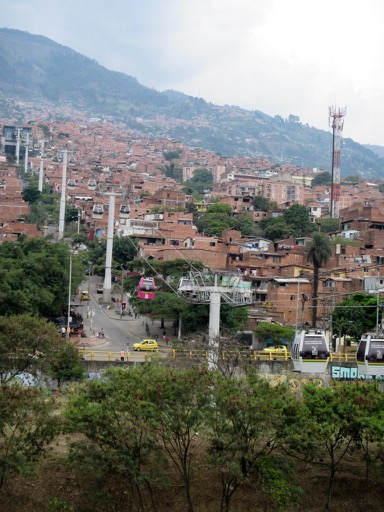
While it took us weeks to make it a few miles down the Colombian coast, we now accelerated our pace quite quickly with a short flight to Medellin. With the boat safely snugged up in Cartagena, we headed to the the hometown of one of the most famous Colombians, our childhood friend John Tobon. Not coincidentally the city was also home to the very successful 80's drug lord Pablo Escobar. (If you haven't watched the Netflix series Narcos, now is a very good time to do so!)
Medellin was the first place we would visit with any sort of elevation to it. Set in a valley, there were many steep hills to be climbed, prompting many stares from locals as we sweated and struggled to catch our breath. The bus from the airport set us down in the heart of the city, a short walk (uphill) to our swanky AirBnB for the next four nights.
 |
| View of Medellin |
 |
| Botanical Gardins |
 |
| Medellin |
The city far surpassed our expectations. In just a couple of days we fully explored the beautiful Jardin Botanico, admired the chunky sculptures in the Parque Botero, took a long walk along the river, ate a lovely meal at a vegetarian restaurant in the Prado neighbourhood, rode the packed metro lengthways through the valley and the precarious cable car up the side of the valley. Due to the bowl shape of the terrain, you can see almost every building from every other building, making for a beautiful view at night. It is evident that the people that live here are still cautious but are enjoying a new, modern Medellin that is growing in a positive direction. They are very happy to show off their city to tourists!
 |
| Parqueo Botero |
 |
| Botero Sculpture |
 |
| Botero Sculpture |
 |
| Medellin Cable Car |
With one day left at our little apartment we decided to get out of the city to a lovely little town a short bus ride away called Guatape. The town is in a lovely setting by a lake surrounded by hills with little cafes, shops, and restaurants scattered about. The building are renowned for their bright paint jobs, each having a mural on its side depicting the lives of a person that lives in or used to live in the house. If you wanted to find the village grocer, fisherman, teacher, or priest, it would not be difficult.
 |
| Guatape Mototaxi |
 |
| Guatape Cafe |
 |
| Guatape |
 |
| Murals |
Leaving Medellin was our first experience with long-distance bus travel in South America. Here is a short comparison of travelling by bus in Canada and Colombia:
- Fares: A hour's trip on the Greyhound from Niagara to Toronto is about $25. 2.5 hours from Medellin to Jardin is $12 and that is on the pricey side!
- Companies: You can count on one hand the number of bus companies in Canada, and for any destination you can usually count it on one finger. In most South American countries bus travel is available from private companies. These companies choose where they will stop, the quality of their buses, what they will charge, etc. It never hurts to keep a mental note of the bus companies that are always broken down at the side of the highway.
- Entertainment: If you're lucky you will get a movie from the 80's played on a tiny little TV monitor on a longer Greyhound trip. In Colombia if you're lucky you'll get a movie from the 80's played on a tiny little TV monitor. If you're unlucky you'll get people getting on at each stop to sing, play instruments, tell stories, tell jokes, do magic tricks, ...
- Stops: I used to get impatient because a bus from Toronto to Niagara would stop in Grimsby and St Catharines. That will never bother me again! Buses in Colombia will stop in every town, on every street going into and out of every town, or just when anyone wants to get on or off the bus. There is also no such thing as a full bus, there is always room for one more!
- Food: If you're taking the bus in Canada you either need to eat a very large breakfast or bring a large sack of junk food. When we brought our own food on the bus in Colombia, Colombians rolled their eyes at us as if to say "amateurs". At every stop, and especially when stopping at "payajes" to pay the toll, there are vendors selling: candy, gum, chocolate, ice cream, chips, popcorn, homemade popsicles, empanadas, mangos, mandarins, tamales, plantains, chicken, fries, and many other things we had never heard of. And if that weren't enough, around lunchtime, buses will typically pull over at roadside restaurants for a full almuerzo, a five-course meal that will leave you wishing you wore your elastic-waist pants on the bus.
I can only imagine that a Colombian new to Canada might take a bus ride and be hungry, bored, confused, and broke!
Our first bus ride took us to the town of Jardin in the heart of the Colombian coffee growing district. The main square was massive and surrounded by dozens of bars serving coffee in dainty little cups to the farmers that had come into the city. We took a little mototaxi up the hill to our second brilliant AirBnB run by Gladys, a little woman bursting with energy and life that spilled over into her cooking, gardening, and conversation. Her house was perched overlooking the valley with a beautiful walk to where a statue of Cristo overlooked the town.
 |
| Jardin Main Plaza |
 |
| Cafe! |
 |
| Valley Around Jardin |
 |
| Jardin |
 |
| Cristo |
 |
| Casa de Gladys |
Leaving Jardin by bus was a bit of a harrowing experience. We had been assured by everyone that there were frequent busses only to find out when we arrived that there were two. And the only one left that day only went to Riosucio. Rio-what??? It turned out that this popular bus route wound its way through the Andes along very steep cliffs high in the clouds with washed-out roads and frequent landslides. Not only were we the only gringos on this decrepit old bus, we were the only people full stop! After a bone rattling 35km trip that took almost four hours, we arrived in the tiny town of Riosucio where we were able to catch what was actually a frequent bus to the city of Pereira.
 |
| Waterfall Near Pereira |
Pereira was then only a short(er) bus ride (you're sensing the theme here) from the coffee town of Salento. We stayed outside of Salento in a farm-converted-into-a-hostel with unlimited coffee (!) and a dog or cat outside every door. Salento is a lovely town in its own right, but is only a WW2 jeep ride away from the Cocora Valley, home to hundreds of massive wax palms, and several small coffee farms from which you can take your pick to do a tour and tasting.
 |
| A Dog or Cat Outside Each Room |
 |
| Near Salento |
 |
| Salento |
 |
| Wax Palms |
 |
| Salento Coffee Tour - Don Elias |
Next stop was the colonial city of Popayan, one of our favourite Colombian cities due to the beautiful architecture, friendly people, and fewer tourists in this area. After a somewhat questionable first night's stay, we decided to splurge for a night and stay in an old monastery that had become a posh hotel. After giving the porter an embarrassing tiny tip because we didn't have any small bills, we retreated to our room for a luxurious hot shower. (We were slowly learning that hot showers were a rare commodity in the Andes. If you were lucky, your shower had a bizarre-looking showerhead with wires coming out of it whose job was to heat the cold water in the brief moment it travelled from the wall to the end of the showerhead. What a simple pleasure to find that sweet spot that maximizes water pressure and warmth!)
 |
| Popayan |
 |
| Monastario Hotel |
 |
| Popayan Parade |
Popayan is a five-hour bone-breaking bus ride to the town of San Augustin whose claim to fame is the discovery of dozens of stone statues over 2000 years old. The final 10km took place in the back of a pickup truck shared with a nun and a couple of backpackers amidst sheer cliffs and waterfalls. We found our hostel, the Casa de Francois, a very steep walk up from the town. But staying in an adobe cottage sourced from local materials was certainly worth it. The stone statues did not disappoint either.
 |
| Casa de Francois |
 |
| Casa de Kate |
 |
| Stone Statues |
After a short trip back to Popayan, we were back on the bus to the southernmost town in Colombia: Ipiales. This is a very picturesque bus ride through the mountains. Other than being quite high up and thus chilly, the most notable thing in Ipiales is its lovely church set into a gorge and bridging the river. Thousands of Catholics have made pilgrimages to this relatively new church, evidenced by all the plaques set into the wall. We made our pilgrimage and returned to Ipiales where the next day we would take a collectivo (shared taxi) to the Ecuadorian border. Adios, Colombia, but we will be back soon!
 |
| Southern Colombia |
 |
| Pilgrimage |
 |
| Ipiales Church |